Showing posts with label authors. Show all posts

Monday, July 25, 2011

Darkness on Monday

I recently had the energy to pick up and read Stephen King's latest volume of short stories, Full Dark, No Stars. The collection won the 2010 Stoker award -- Joe Hill tweeted very nicely about that -- and I'd read other good reviews of the collection and thought it was probably time I got around to it.

In my opinion, King is almost always better in short than long with the possible exception of the Dark Tower series and even there he starts to suffer from verbal diarrhea more than once. Man just can't stop once he gets started.

I'm not saying that this collection is the exception -- the four long-ish stories in it ("1922," "Big Driver," "Fair Extension," and "A Good Marriage") are pretty good. Solid King, you might say; there are all his old familiar tropes: man kills wife; woman kills attacker; deal with the devil; horrible discovery in family. There's nothing here that you haven't seen before if you've read more than one King novel or previous collection of short fiction.

What caught my attention and prompted this post is King's insistence, and that of several reviewers I read, that these were his "darkest" short stories. In his afterword, he specifically describes them as such, talking about how dark and serious and disturbing they are.

I read the volume at a go one hot Sunday afternoon, read the afterword, and sat there thinking, 'Dark? Dark? Mr. King, sir -- what is this dark of which you speak?'

Sure, the stories are vintage King as described above but I don't know if, in all fairness, I would describe any of them as being darker than, say, "Dolan's Cadillac," "You Know They Got A Hell of A Band," or "Home Delivery" from Nightmares & Dreamscapes. Or "The Raft" or "The Mist" in Skeleton Crew. Or "The Road Virus Heads North" in Everything's Eventual.

And then I started to wonder about what I mean when I said "dark" and what King might mean -- and then I decided not to worry about that because trying to figure out what someone else means when they use a word is pretty much a mug's game unless they're standing right in front of you and you can ask them. I'm not going to trudge all the way up to Bangor just to bang on the man's door and ask him an obscure question about the afterword to his latest book.

What I do know is that none of the stories in Full Dark had the same feeling of menace, of inevitable doom, and of bleakness that I think make the stories I named above so genuinely dark and threatening. Take "The Road Virus Heads North," for example -- it's a pretty basic "purchase a haunted/possessed item -- purchase the haunter/possessor" story. A man stops at a yard sale, is struck by the painting of a young man in a muscle car heading north over the Tobin Bridge from Boston, and buys it. As he takes it further north with him towards his home, the painting begins to change. It becomes clear to the reader, if not the poor sumph of a narrator, that he's being followed. Perhaps even hunted. I find "The Road Virus" terrifying -- every time I read it, the inevitability of the narrator's pretty ghastly demise is still frightening. The doom he manages to avert from some of the others along the path of the Virus is awful -- the implacability of the antagonist quite real.

And check out "Home Delivery," man! Woman alone on island facing birth of first child after the descent of the zombie apocalypse. Bad enough? Oh, did I mention her husband drowned recently? Yeahhhhhh -- think that one, through. And keep your knitting needles handy. What I like about "Home Delivery" is the common-sense approach of the character to an unbelievable situation; yes, it approaches the pragmatism of the narrator in "Big Driver" (once she gets done being traumatized) but "Big Driver" then descends into a straightforward rape revenge drama. Pretty rote, once you figure out what's going on. "Home Delivery" takes you on a hell of a ride, not forgetting the heaving cemetary dirt scene.

I think what these stories have in common that I didn't feel in any of the work in Full Dark is a sense of claustrophobia, fear of something awful that you can't get away from. Yes, the characters in Full Dark, in "Fair Extension" and "1922" particularly, are doomed by their actions -- but their actions are also avoidable. There's no point in any of the stories when you feel, "Aha. There's the click. The key's turned in the lock -- hell, that fucker's broken off in the lock, and here we go." It always seems reversible. There's no sense in this collection that the you can't kill the boogeyman -- in fact, in "A Good Marriage," that's exactly what the protagonist does. Yes, it's horrible; yes, her journey of discovery is wrenching; but it also doesn't feel as immediate and as clutching as, say, the fate of the teenagers on "The Raft."

None of the stores in Full Dark have that feeling. Yeah, in "1922," the narrator pretty much buys his own ticket to hell by bludgeoning his wife to death and getting his son to come in on the deal. But the rest of the story is really just an exercise in Lovecraftian inspiration and a long-drawn out version of HPL's "The Rats in the Walls" -- except not as good. (Sorry, Mr. King.) "Big Driver" is just -- well, I thought it was just bad. We don't need to go into why.

Anyway, the point of this post was not to get into trashing the stories in Full Dark -- they're worth a read, particularly in you're a King fan. I just wanted to say that I don't think they're very dark; perhaps there's just a twinkle or two in the sky -- maybe the glow of a city in the distance. That's all.

Wednesday, June 9, 2010

history notes: david kynaston, the "britain" series

having semi-successfully fought the head cold to a stand still, i took the opportunity of so much time in a prone position, to finish the second volume of david kynaston's giant -- and i do mean giant, the volumes are only a little under three inches thick -- history of britain, family britain. i already finished off austerity britain a few weeks ago. the first volume covers the years 1945-1951; this second, 1951-1957. each of these two volumes is actually an omnibus of two original volumes printed under different titles. i can only assume that this was a publication decision made for an american market: each of the four, individually printed, wouldn't do well, so bung 'em together and call it a day. i can't say that i think this was a bad decision; it certainly makes them easier to get through like this.


the good stuff: endlessly amusing anecdotal evidence; plenty of stuff about pop culture (the origin of the bbc, 1940s-1950s radio and tv programming which i find fascinating and familiar); good leaves of photographs; broad coverage of all kinds of events from political to personal; nice index; good sources if you feel like wading through all the freakin' end notes. (really. end notes are just made of evil. you know the references are in there but finding them is like wading through an unfun labyrinth.)

the bad stuff: the anecdotal evidence. while it's charming and kynaston depends on a small crew of diarists -- mostly middle or lower-middle class -- to bring out "ordinary" life in britain during the period, he's also totally unanalytical about it. just because someone wrote it in a diary that, presumably, wasn't meant for public view or publication, he takes it as truthful, unbiased, "genuine." "genuine" is one of his favorite words; as is "authentic." the thumbnail rule here is: the lower the class, the more authentic.

this is very obvious bollocks.

the more you think about it, the more crap it becomes. it presumes that someone living at a certain income level has a more direct line to "truth" than someone else at a different level. it would be nice if it were true; then all you'd have to do is find the lowest socio-economic denominator and, boom! one history book per period and truth is found! unfortunately -- or fortunately 'cause how boring would that be? -- it doesn't work that way. the lack of context, lack of analysis, lack of thought put into the use of these sources -- which are mouthwateringly wonderful to someone with a pickier turn of mind -- is really a shame. they're more or less wasted on the page, reduced to being just another form of history as just "one fucking thing after another."

kynaston also comes across as more than a little pedantic and condescending to his lower-class subjects in a very obvious way that can be kind of cringe-making to read. in the second book, particularly, his attitude veers from the patriarchal to the outright snobbish to the overly sympathetic, "we're all lads together." the lack of analysis i talked about a minute ago leads him to take almost everything at face value; therefore, the presentation by the sources of lower-class and working-class life as a constant race between work, home, and the pub is, for kynaston, the truth as revealed by the source. he quotes a page and a half from a working man's diary, then summarizes it as being work, alcohol, betting, and says that this is what you could "call" working-class "culture." the snobbery practically drips off the page. while the rest of the english world, apparently, was fascinated by the comet airplane and the premiere of "look back in anger" and "waiting for godot," the poor benighted (largely northern) working-class just couldn't get its head out of the pub or the football game.

and this is beyond the fact that the diary as quoted says no such thing! an analytical historian would have been able to pick out threads of family life, concern about wages, worry over ailing family members, pleasure day trips -- a whole world of concerns and enjoyments outside of the pub and the football game that kynaston is happy to subsume in a stereotype.

Monday, May 17, 2010

"deadwood" meets "harry potter"?

i was planning to write about something other than a book on monday but i haven't managed to find time -- or energy -- to watch 44 inch chest or to finish the new rsc production of hamlet from 2009. (although i watched the first two acts -- just about -- last night and i have to say that, biased as i am, i think david tennant deserved pretty much every accolade he got. he's amazing.)

but anyway that's for a later day when it isn't so lovely out and the temptation to go for long (somewhat limping) walks isn't so great. i'm looking upon my recently wrenched ankle as a reason to investigate new coffee shops along my usual walk routes since it really is unreasonable to expect someone to stay inside during one of boston's two nice seasons which last about, oh, a generous two weeks at most?

in any case, the topic for discussion this monday is caroline stevermer's a scholar of magics, a sort of sequel to a college of magics -- if you have a good solid title pattern going, why break it right? but seriously, scholar is great fun -- instead of following on directly from the last events in college, scholar picks up sometime later and, instead of following faris, our first heroine, which would have been fun but possibly a bit frustrating, scholar follows jane brailsford. now, i didn't mention jane very much in my earlier review of college, but she's one of the best parts. she's faris's fellow scholar/friend/companion/chaperone/teacher/general aide-de-camp. she's very english and sort of like a cross between harriet vane, amelia peabody, and mary russell. a good combination, i hasten to add!

the plot outline runs something like: in the first book you got to see greenlaw, which is the girls' school for magic; now you get to see glasscastle which is the boys' school for magic because this is england (nominally) and we couldn't have any naughty co-ed mingling. no no no. absolutely not. a*hem*. anyway. one of our protagonists is jane, sent back to england by faris to try and resolve an issue with the warden of the west; the other is samuel lambert, an american sharpshooter working temporarily at glasscastle on some mysterious magical project.

there's the same kind of marvellous dialogue that kept me reading even through the dry spots in college and -- three cheers! -- far fewer dry spots! glasscastle is a much more regimented, faintly misogynist, rather unsympathetic place to focus half the novel, but some of the people in it -- including lambert, who falls in love with the place -- are very lovingly drawn and it's rather hard to dislike them even when they're making fairly obviously stupid claims about the capacity of women vs. men. plus jane's almost always on hand to disprove them which is just awesome.

scholar also moves a fair bit faster than college -- i read it comfortably in an afternoon and once the pace gets going -- a few chapters in -- it's a very seductive read.

Monday, May 10, 2010

magicians, sheepdogs, and ley lines

two short book reviews for you this monday morning. think kind thoughts for me, please; i'm off to go get a CAT scan done. joy of joys.

first off, the last volume of the kate and cecilia series of young adult fantasy novels, the mislaid magician. i won't add the whole subtitle, save to say that it goes on for quite a while. i've got short reviews of the first two volumes in the series, the enchanted chocolate pot and the grand tour.


the mislaid magician takes place ten years after the events of the grand tour. kate and cecy are happily married to their respective thomas and james (i finally succeeded in remembering who was married to which!) and have produced between them quite a staggering brood of children. those i did not sort out, but it didn't really matter who was whose since, for most of the book, they were all staying in a gang with kate.

the major plot of this entry in the series concerns the development of the railways in the north of england -- it isn't quite like cranford-with-magicians, but the parallels are tempting. a foreign magician, brought in to do some surveying, has gone missing; kate's annoying cousin, georgina, has descended upon her for a visit which shows no sign of ending; bizarre prowlers are wandering about kate and thomas' estate; and the duke of wellington wants james and cecy to locate the missing herr magus somewhere around leeds -- the back of beyond, as we are frequently reminded.

magician was nearly as much fun to read as the first two books, but it did get a bit longwinded in the middle. there are letters not only from kate and cecy but also from thomas and james, which adds a bit of novelty to the epistolary format, but thomas and james's letters often start with something like "you'll have gotten the overly dramatic version via my wife..." or "of course, as cecy likes to exaggerate, i thought i'd better send you the real version..." which gets very old very quickly. and for the sheer number of children there were around, i wish they had had more distinct characters or purpose or something. given that, really, only two or three of them -- out of what seemed like at least a dozen -- had anything direct to do with the main plot or any of the subsidiary plots, it was a little hard to care very much about them or understand what they were doing there.

still, magician was a fun way of passing a rainy saturday afternoon.

the second entry in this omnibus post is caroline stevermer's a college of magics. this is a standalone, but it feels a lot like a kate and cecy novel. it has the same alternate history setting; the same touch of magic over real politics and events; and, obviously, a fairly similar authorial voice given that stevermer is one of the authors of the kate and cecy series.

magics, though, is a little more meaty. there's more character development as well as (occasionally) frantic plot development; there's a larger framework for the events of the story; and there's sex (not much, but it's there), blood, violence, betrayal, money, and revenge. so, really, all the requirements!

the story opens with our heroine, faris nallaneen, being sent off by her "wicked uncle" ("yup -- standard issue!") to a magicians' school somewhere between france and england. whether she's being sent there really to learn or simply to be gotten out of the way while her uncle usurps her political power in her home country of galazon is something of a mystery that isn't ever really cleared up. the story focuses pretty tightly on faris and her struggle to get back what she feels is her rightful place as ruler of galazon.

faris can be an annoying protagonist, but she's never uninteresting and stevermer writes some fantastic dialogue for faris and her group as they assemble at greenlaw -- the college -- and then have to travel back towards galazon, outwitting the usual hazards of the journey: late trains, hired assassins, and parisian dressmakers. i can't say there's anything terribly serious in here -- but there are some startlingly moving moments in the last few chapters as the final confrontation goes through its paces.

so, yes, pick up magician for the afternoon when you have nothing particularly better to do and magics for a nice sunny afternoon when you have some lemonade on hand and maybe a nice tree to sit under.

Monday, April 12, 2010

"...better than chocolate..."

i remember reading an essay by patrick mcmanus once in one of his earlier collections -- they shoot canoes, don't they? or maybe the grasshopper trap? -- about reading habits, winter vs. summer. when winter came around again, you would be back reading the heavy thinkers: "jacqueline susann, erma bombeck..." and so forth. likewise, terry pratchett in the last continent, mentions that there is a rule that any book taken onto a beach for long enough and brought into contact with enough suntan lotion and coconut oil will inevitably morph into a tome with a title like the omega precedent or the alpha adventure and be almost entirely filled with weapons specifications.

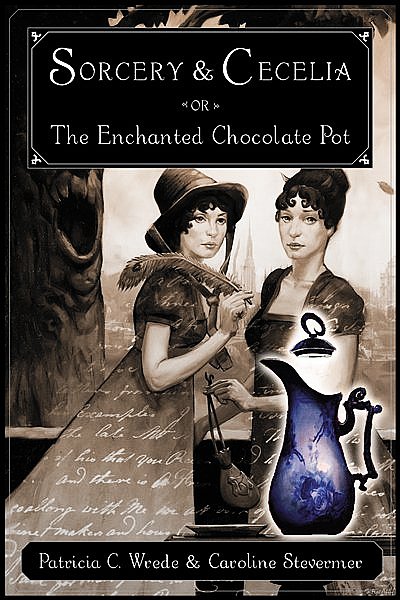
i can't say that this has happened to my reading list of late, but i did find it was a little tough lugging around marianne elliot's latest tome on the history of catholics in ulster -- it weighs as much as my water bottle! -- and so, based largely on a recommendation from jo walton on tor.com, i went and found patricia wrede and caroline stevermer's epistolary historical fantasy, sorcery & cecelia at the brookline public library.

spoiler warning: none, really. it's too cute to spoiler for you and really too much fun to tear apart.


sorcery is a sweet, charming, fast read -- you could get through it easily in an afternoon. the only real issue i had with it was the similarity of some of the names -- the men all seemed to have the same number of syllables in their names and, until about half-way through the book, i didn't feel their characters were distinct enough for me to keep them apart based on name alone. i solved this by memorizing which man was where -- london or essex -- and going by that!

the story is straightforward: the two narrator characters, both young women, are swapping letters from london and essex, describing the progress of one's london season and the other's adventures in the countryside. in this universe, magic is a real and socially acceptable phenomenon; one of the girls comments early on in the story about an academic and magically minded neighbor going up to london to be inducted into the royal college of wizards. (one is reminded, somehow, of the reclusive mr. norrell in jonathan strange & mr. norrell.) there are complications with attractive and surly young men, repressive aunts, difficult cousins, and the impossibility of persuading one's relatives to shell out for the right kind of dresses. it's sort of like jane austen with spellbooks. (definitely minus zombies, though.)

quite a lot of this book is like susannah clarke's later fantasy -- the time period (napeolonic wars); story elements (the wizardly neighbor who loves his books); the involvement with political affairs (magicians campaigning with wellington). but the similiarity doesn't make this book boring and doesn't make it seem as though clarke ripped her idea from wrede and stevermer.

it isn't all light fluff and chat about dresses, although there is quite a bit of that. there's a real sense of darkness and danger here; the consequences for messing about with little-understood magic or irritating a higher-level magician are made to feel quite real. i'd say the freakiness really gets going on page 21 when kate, in london, writes to her cousin of a woman she has stumbled upon:
Her skin was smooth and carefully painted, her eyes were dark and very hard. She smiled kindly at me and asked if I would take chocolate with her.
You and I often played at dolls' tea party together, Cecy. I will never again remember such games with pleasure.
anyone who has read neil gaiman's short story "don't ask jack" should be totally aware that children's toys are not great in pretty much any way, shape, or form -- particularly when they show up in genre fiction like this!

there are two more books in the series -- really! there are! i checked and doublechecked and they're both published and available! -- and i'm planning to track them down via library as soon as i can.

Monday, March 29, 2010

time clogging

so i dithered a bit about writing posts for this week, particularly after pondering in my post on repo men last week -- another rip of which can be found on tor.com if you're into that sort of thing -- about why genre fans insist on getting respect, yet refuse to play nice with their own genre.

and i dithered because, really, my temptation for this week was to write at least one juicy good rip of a movie, but that seemed a bit hypocritical, so we're starting instead with the book review which is at least slightly more positive.

a few weeks ago, i wrote about steve cash's the meq and made a subsequently totally unjustified comment about the second book being due out this year. it isn't. it's been out for several years. i'm a dork and should have checked my facts more thoroughly first! i swear that i did read something about a new book of his being out sometime this year -- perhaps it's the third in the series since the second volume ends with a cliff-hanger so blatant it barely justifies being called one. it's so obvious by about half-way through the book that nothing whatever is going to be resolved in this volume that the cliff-hanger is more anti-climactic than anything else.

as sequels go, time dancers isn't bad. but that's about as far as it goes. it isn't bad. i was really hoping for quite a lot more. since the first novel, the meq, was a pretty ambitious gambit with quite a lot of charm to it, i was willing, so to speak, to give cash quite a lot of rope to hang himself. after all, not everyone can write heart-shaped box, neverwhere, or garden of iden right out of the gate.

the story for time dancers is pretty basic: without giving away anything critical, i can say that it takes the characters from 1919 to 1945; they're still searching for answers about "the Remembering" (which also has some rather spiffy sound meq word that i can't recall); the villain is still out there being villainous; and there's an awful lot of running around. seriously. these people do more transatlantic/pacific travel in about two months than most of us do in a friggin' lifetime. and they do it fast, too. no storms, no customs hold-ups, no lost luggage, nothing. you want to go to paris from st. louis? boom. fastest trip you ever had in your life. and in 1923, too!

what i really wanted from time dancers was character development. some enlargement on the plot would have been nice; a sense of where the meq stand -- or have stood -- in terms of the regular human history of the world would have been good, too, but what i really wanted out of this book was to see zianno and his other meq companions do some growing up even if they can't grow up.

i wanted to see them deal with watching their human friends age and die; with their own inter-relationships; with sex, for heaven's sake! there was this big deal made in the meq about the "one for one" nature of relationships between the meq -- is that it? is that the only type of long-term "adult" relationship they ever have? never a passing fling with the odd regular human? and, if that's the case, then how does that work? how do two twelve-year-olds go through the world as lovers when the rest of the world sees them as children? are they actual lovers or just "good friends" until they decide to end "the Itxaron" and enter the real flow of time to have children? and just how lame is that: you have to choose to die in order to reproduce? don't we have enough stories about immortal characters who have to do that already? and there were just enough almost-answers to my questions to keep me reading, but they were thin enough to leave me disappointed.

instead of character development -- or even deeper plot development -- time dancers is really one long rush of action in which nothing really happens. some characters we've been familiar with since the meq die -- but since they haven't been fleshed out at all since the meq and since zianno's narrative voice hasn't changed at all in how he describes or relates to them, it's a little hard to get worked up about it. the characters seem to have retreated to be bad caricatures of themselves: carolina is always caring and welcoming; sailor is always mysterious and serious; owen is always helpful and competent. characters become more like strings of unchanging adjectives and physical characteristics than actual people. it's a shame, really, because cash had some great characters and he doesn't do much with them.

the rush of the action is almost enough to let you forget this for about half the book; then i, at least, started to find it really annoying. that, and the habit almost all the characters developed of never answering a straight question: "well, what happened with [fill in the blank]?" "now is not the time for you to know that." i wanted just one person to say, "well, obviously i think it is, you doorknob, so how 'bout we try it my way for once and see what the hell happens?!" and, as a trick to increase tension and delay revelation, it got to be obvious when it happened in every.
single.
conversation.

so, yes. i wasn't unreservedly thrilled with time dancers. cash's trick of dropping in historical figure to spice up the action got old more quickly this time. more than that, though, i was really disappointed that the characters were still essentially the same as they had been in the first volume. i was hoping for some deepening of the vision, some sense that perhaps not all of the meq zianno hangs out with are trustworthy (there's a couple i wouldn't trust as far as i can throw a dead rat), or even a feeling that perhaps not everyone tells the truth all the time.

i'll read the third volume, but i'll read it for the villain. so far, he's the one i'm still most interested in!

on the other hand, cash does just get a whole crap-ton of points for lugging in -- almost entirely without reason or need -- leon bismarcke "bix" beiderbecke, a 1920s jazz musician, a cornet player. and why is this, you ask? it is because i am a complete devotee of the alan plater beiderbecke series: affair, tapes, and connection. i tried to find a youtube clip of the opening or even a decent trailer but all i could find is what you see below which is a rather random collection of clips from the first series, the beiderbecke affair. if you like what you see -- and, really, what's not to like? -- i strongly suggest finding the series to watch; they're all about equally weird, random, and charming, but i personally like the first series best.

Wednesday, March 10, 2010

"deadwood" with immortals. sort of.

on saturday, since i was trying to rest-and-heat painful cramps out of my right shoulder muscle, i had a lot of time to read. i finished roy porter's english society in the 18th century and steve cash's the meq. i've read articles by porter before and excerpts from his books but not a full text and it was great -- he's a little addicted to cheesy wordplay, but it was kind of cute, and it was a great survey of exactly what the title says: english society in the 18th century. tah-dah. no surprises here, folks. i don't know enough about the subject to know if what he was saying was revolutionary or so ordinary that it caused no surprise whatsoever, but it was amusing, quick to read, and could absolutely have yielded more to closer inspection which i think is always a good thing in an academic text.

the meq, on the other hand, isn't an academic text about anything. (mild spoilers follow; nothing that will ruin the ending, i promise). it's steve cash's first novel; his second, the inevitable sequel to the meq is coming out sometime this spring/summer. the basic conceit of the book is that there are people, called the meq, living on the earth who are functionally immortal. this sounds great -- until you realise that their immortality switches on, so to speak, at age 12 and they don't age past 12 unless they decide to re-enter time in order to have children which they only do after they have met their "ameq" -- roughly translated, "soulmate." (tangential question: how many fantasy/sci-fi novels are there out there that somehow have a concept akin to "one person for one person"? you meet your "perfect mate" or you never get a long-term relationship? why is this?) the period until the ameq is found is called the "itxaron" (i may be spelling that wrongly) or "wait."

i'm not sure where cash got the words he uses in this; most of the meq are meant to be from the basque area of northern spain/southern france, so i'm not sure if he adapted/adopted portuguese, basque, or possibly provencal french. some characters speak what is recognizably portuguese or french, interspersed with english, obviously, but the words that pertain specifically to the meq didn't ring any bells with me. they're evocative, though, and do a pretty good job at distancing the meq from the humans they live alongside.

the narrative character, zianno or "z" as he insists on being called, loses his parents just after his first 12th birthday and knows nothing about the meq or about his place in the hierarchy of this scattered society. obviously, he turns out to be important; there's a quest, people to be found, objects to be found, villains to be bested, questions to be answered, and so forth. it's a fairly straightforward hero's journey.

as a first novel, it's pretty good. there are at least two historical and one plot-related "howlers" as harriet vane calls them, but they're forgivable given the enthusiasm and verve which cash brings to his story. (i won't point them out in the interest of not ruining things for you. suffice it to say, if you notice them, you notice them; if you don't, you don't.) it wanders a little; in the middle chapters i couldn't help wishing that there had been a kindly editor on hand to suggest that maybe, just maybe, some of this could be condensed somehow. and cash did occasionally give in to the temptation of the "if only we had known then what we would shortly discover..." trick which i find hellaciously irritating. it's one of stephen king's little pet foibles and sometimes -- just sometimes, mind you -- it works out all right. lovecraft used it to good effect and there's the odd stephen king novel -- it, for example -- where it doesn't drive me up the wall but mostly it just seems like sloppy storytelling. it's like telling the reader something but not really.

since the story takes place over the last decade or so of the 19th century and ends just after the first world war, cash occasionally has real people enter the action -- mostly very briefly -- and real-world events continually impinge, aid, or retard the action of the story. the novel ends amid the upheaval of the armistice and the opening days of the influenza epidemic at the end of the teens. cash does a great job of evoking the 'flu epidemic, making it particularly horrific when it becomes clear that the 'flu may not necessarily be a respector of meq immortality.

there are some great characters -- solomon birnbaum and carolina covington spring straight to mind as two favorites, as do ray and sailor, two of the other meq z falls in with over the course of the novel. the villain, too, is a wonderful, cruel, vicious invention and i thoroughly look forward to seeing more of him in the second novel. there are a few characters that come across as stock figures, inserted to make a plot point move more smoothly or to ease a particular transitional moment, but for the most part, cash avoids this kind of cardboardy characterization.

there are some things that i wish he had addressed in more detail: for example, all of the meq -- some of whom were thousands of years old and still, apparently, 12 -- lived closely with humans...but none of them expressed any real jealousy, sorrow, or pain at watching human friends age, marry, divorce, get sick, die, or whatever. but perhaps these are problems that cash was deliberately saving for his second book when z would be less preoccupied with finding his feet, so to speak, as a meq and could turn his mind to more abstract ideas.

edit: i take it back because i am an idiot. the meq was published in 2005; time dancers, the second volume, was published in 2006. perhaps he has the third volume coming out this year...? i have no idea. anyway. yes, go forth and read those two lovely complete volumes and just totally ignore me, really.

Monday, March 1, 2010

short thought: "the swan thieves"

so a short thought this morning, folks, on elizabeth kostova's new novel, the swan thieves.

the reason for this shortness? well, partially it's because i have to go to work shortly, but mostly it's because i didn't finish the book. i'm breaking my own self-imposed sort of rule here to talk about a book i didn't even bother to finish. most of the time, if i write something about a book, movie, or series, i haven't finished it's because i think it's completely awesome and as many other people should know about it as possible.

i wish this was the case with the swan thieves but it's not.

i really enjoyed kostova's debut novel, the historian. it had problems of pacing and characterization but, for a first novel produced out of a workshop, i thought it was pretty damn good. a few of the other little glitches i noticed -- such as the strange adolescent/adult/adolescent/pre-adolescent slalom of the main character -- can be explained by the fact that one of my friends who attended a talk on YA literature told me that the novel had originally been purchased as YA. the publishers then realised they would have a much wider market if they bumped it up to the adult fiction lists, but the main character, having originally been written to appeal to a pre-teen/teen audience, needed bumping up, too. thus her odd bouncing around between states of mind.

fine, i'll buy that. it mostly worked anyway, and didn't distract too badly from the rest of what was going on. it wasn't exactly a fast-moving book by anyone's standards, but it was worth the ride 90% of the time.

the swan thieves is equally slow-moving, equally detailed, equally determined to leave no stone unturned in terms of character or plot description. in this case, the story is much simpler than that of the historian: a painter, robert oliver (if i remember rightly) has been arrested and institutionalized after trying to attack a painting in the national gallery in washington. his psychotherapist, one of the narrators of the story, is trying to figure out why. tah-dah -- there you have it, folks. the entire driving force of a brick-thick novel.

and that's fine -- it might even work out -- if every character didn't feel like a cookie cutter of every. other. character. seriously. i think kostova developed one man and one woman and then just changed hair color, age, and eye color. and it got really really boring to have every woman described in terms of her immediate sexual attractiveness to the narrative character. since in his original self-introduction he mentions that he starts out the story single but not particularly heartbroken about this and that while now he has a wife and is quite happy about this, romantic heartbreak hasn't been a huge portion of his life, it felt particularly awkward to have him summing up every woman in the story in terms of waist firmness and breast size.

to then have the narrators switch -- which was fine; i expected that -- and the new voice of a younger woman was interesting to listen to right up until the point when she started evaluating all the men in the book in precisely the same way the original, male narrator had! i suppose this is a very mild example of equal opportunity sexism, but between that and the fact that the pace of the novel was tooth-achingly slow without delivering any of the informational payoff of the historian, i decided life was too short and, to quote maggie cutler in the man who came to dinner, "i put it down right there."

Wednesday, February 10, 2010

"and god said let newton be and there was light..."

i'm in the middle of reading thomas levenson's newton and the counterfeiter: the unknown detective career of the world's greatest scientist.

i suppose i should have realised more clearly what levenson's bias was going to be by paying slightly more attention to the post-colon title up there: "the world's greatest scientist." levenson is director of the graduate program at mit and a faculty member in their history of science writing program. i discarded it very quickly because it became clear that their priorities were not mine and, honestly, 19th-20th century ireland were going to cut next to no cheese with them, but the program looks really neat. (and a brief search on the mit website looking for more info about levenson reveals that the program no longer exists under the name i remember, so perhaps the focus has changed since the last time i looked at it.)

levenson writes exceptionally well; if he teaches his students to write like this, that program must be putting out some masterful science writers. his research, too, is solid; he states right up front what sources and collections he has relied on, where he feels the holes are, how he has tried (or failed or not bothered) to fill them, and what implications this might have for his argument. i love this kind of 'lay the cards on the table' attitude in history writers from whatever field. i'm much more likely to nod and go along with someone's argument if i know that they know where the gaps are right up front. there are gaps -- there are always gaps. you simply can't cover everything and that's okay. every history text would be about 12 volumes of 3,000 pages each if everyone tried to be comprehensive all the time. and then a further 12 volumes of footnotes and bibliography.

i have a couple of issues with the book, though. one is that levenson is very dismissive of anyone who isn't newton and newton -- and his radically new vision of the world -- is so clearly an end point for him... "there was newton and then everything was good," could be his attitude summed up in a trite little phrase. i hope that he's taking this reductionist attitude because the book is short, it's clearly meant as a pop history, and he doesn't want to get caught up in the details of debates over newtonian physics. but i find it worrying that he dismisses everyone else working in the same field at the time as being lesser than newton and therefore, implicitly, not as interesting or worthy of attention.

the second -- and more worrying from my perspective because i love print history and intellectual history -- is that, when setting up the conflict between newton (warden of the mint in the late 1600s/early 1700s) and william chaloner (professional forger, cheat, and trickster), levenson is talking about the flood of pamphlets that came out in the late 1690s to suggest ways of fixing the monetary problem in england. basically, the country was out of money. there are all sorts of reasons for this; if you want the entertaining fictionalized version of this, i urge to you read neal stephenson's baroque trilogy -- and then, please, come back and explain it to me.

levenson does a great job explaining the fiscal crisis; i nearly understood it this time 'round! and that fault is mine, not his. i find economics bewildering at the best of times. but one of the key issues in all the (very public) debate and argument surrounding the recoinage of english currency and state support for money and so on was the huge number of pamphlets and the like that got put out by almost anyone with an opinion and money to have the printing done. all sorts of people had suggestions about what should go on, including, at one end of the social spectrum, william chaloner and, for comparison's sake, at the other end, john locke.

so that's all fine and good -- but in the middle of talking about chaloner's pamphlet to suggest what he thinks would be a good idea to fix the mint -- which is really the set-up to an elaborate fraud he wants to run -- levenson suddenly refers to chaloner as being 'illiterate.' now, this may have been meant as a snide joke to point out how snobbish newton was; it may have been an editorial slip that didn't get caught in the final trimming process, but it really struck a sour note i had a hard time getting by. there wasn't any reference in the text to chaloner getting someone else to write the pamphlet for him, or anything like that, so i found the sudden reference to him as 'illiterate' baffling.

i wish i didn't have to return the book to the library tomorrow so i could finish it properly and figure out what was going on. i'll get it back out, of course, to finish it -- if for no other reason than the hope of once-and-for-all figuring out what the hell is going on in stephenson's the confusion -- and because, despite my niggling about it, it really is quite good.

Wednesday, January 20, 2010

"she is...not complete yet."

brief book review: the life of louis xiv's mistress, athenais, the real queen of france, by lisa hilton. i'm not bothering with the diacritics in athenais' name. i'm sure i could get blogger to add them in but, really, just imagine them. there's a long 'e' accent and an umlaut over the 'i.'

the good things: highly readable; well-written; clever; good bibliography.

bad things: hilton's attitude towards the people (women) she's writing about; lack of footnotes; poorly reproduced graphics.

taking them in reverse order: the graphics probably aren't hilton's fault. it's a trade paperback with full-color paintings reproduced in black-and-white. they're okay for reference but lousy for getting an idea of what people actually looked like. there are some interesting issues here to be discussed about the reliability of portraiture particularly if the client is the king of france standing six feet away glaring at you from behind your canvas and if you don't make him look damn good, the guards at the bastille may be your new best friends. hilton doesn't talk about this.

there are too few footnotes. there are always too few footnotes. this is my personal issue and i accept it. i love footnotes. they are your best friends when it comes to following an argument and deciding whether or not the book is worth the time you're spending on it. in this case, i'm forgiving a lot because hilton has a kick-ass bibliography, some footnotes, and has done some of her own translations.

her attitude towards the people she's talking about, however, i find somewhat more difficult to deal with. she's talking about the court of louis the xiv in the second half of the seventeenth century and specifically about louis' second mistress, athenais de montespan (married name). this is all fine and quite interesting. i can leave aside the fact that she insists that louis was the outstanding monarch of the seventeenth century (in a century which also features james i, charles i, charles ii, and james ii of england) or that louis' court was the best and the brightest ever invented (see restoration england.) everyone thinks their period and their subjects are the best and the most exciting ever. that's why we write about them. if we didn't think they were fascinating, we wouldn't spend hours and hours and hours in archives, reading rooms, microfilm rooms, library stacks, and more and more hours in front of desktops, laptops, netbooks, notebooks, legal pads, proofs, galleys, and other detritus of the publishing industry trying to tell other people about them.

but hilton's attitude towards the women she's writing about seems particularly peculiar -- she discounts anyone who wasn't deemed to be physically attractive. louis' queen, marie-therese, is described almost solely as being unattractive. other women at court who don't come up to the mark of physical beauty set by athenais are discounted as being below the required standard. some of athenais' rivals at the court -- other women, married or single, who might have been on the make for louis' affections -- are described as having the envy of unattractive women for a beautiful one. the hanoverian palatine elizabeth-charlotte -- by other accounts that i've read an incredibly influential and intelligent woman who used her time at louis' court to observe the vagaries of the french aristocracy as well as doing her best to further her own political interests from the palatinate -- is also dismissed as being plain, dumpy, and, obviously, therefore of no interest to anyone. marriages that aren't between two partners of equal attractiveness -- judged by the aforementioned standards of portraiture which i would have thought would be highly suspect -- are clearly dysfunctional and doomed to failure.

yes. thank you. because of course all motivations for women -- or, indeed, almost anyone else in hilton's account -- can be resolved down to the matter of 'who's the prettiest.'

i could get quite catty here about the fact that hilton herself, to judge from her jacket photo and author biography, is quite gorgeous and, apparently, an ex-model. i'm sure there are some interesting conclusions to be drawn here. i'm not going to do it. i feel some (bad) jokes simply make themselves.

Sunday, January 17, 2010

theobromos cacao

this is not a post i wanted to write.

kage baker, one of my favorite authors, is dying. there are a couple of stories about it here and, from tor.com, here.

i never write to authors. ever.

i'm going to write to her because her books are phenomenal.

if you haven't read them, you should. they're hard to find but, i promise you, it is worth it.

it is stupid and awful and pointless that there won't be any more of them.

Thursday, December 3, 2009

"such a lonely little boy. lonely then and lonelier now."

last night i finished my last grad school library science paper. perhaps in after years this will take on major significance in my life, but mostly it was just another paper and i wrote it and now it's done and i'm okay with that.

i managed to wrangle out a paper topic i was rather proud of. in the face of a suggested list of topics from my professor which included "write about the history of a typeface" and "consider biblioklepts over the years" (okay, they were really cooler than that, but you get the idea), i put together a proposal to write about the history of books in horror fiction.

really, this was just an excuse to re-read a lot of h.p. lovecraft and call it schoolwork.

and it mostly worked. i can't say this is the best paper i've ever written or anything like that, but it's a fairly solid paper; i know it would go over well with either of my history professors, but the lis professors are a peculiar and uneven crowd and difficult to foreguess. we'll see what happens. i am proud of myself for writing a single paper which allowed me to footnote -- within nine pages! -- jane austen, neil gaiman, stephen king, and neal stephenson. oh, and some academic'y stuff, too.

anyway, this is really one long lead-up to what i actually wanted to talk about which was a biography of m.r. james that i read for the paper. (i mostly wrote about two short stories james wrote -- "canon alberic's scrap-book" and "the tractate middoth" and a bunch of miscellaneous lovecraft including "the case of charles dexter ward," "the dunwich horror," and "at the mountains of madness.")

james was a late victorian, born in kent in the mid-nineteenth century, went to eton, then to king's, then proceeded onto the kind of calm, untroubled academic existence that e.m. forster and evelyn waugh, in very different ways, blew right out of the water with maurice and brideshead revisited. (to say nothing of dorothy sayers and gaudy night.) so, in order to garner any useful biographical details -- perhaps best described as "gobbets" in the tradition of irwin from the history boys -- about james's career as an antiquarian and rare books enthusiast for my paper, i read this biography, m.r. james: an intimate portrait, by michael cox. published in 1983 and before you ask -- how can it then be "intimate" when the author was, at best, an infant when the subject was in his last years? who knows. your guess is as good as mine. personally, my guess involves thinking that cox wishes he had been at cambridge in the '80s, '90s, and '00s rather like noel annan and his the dons. fairy tales for the true ivory-tower academic? maybe. we probably all need 'em on some level.

better him than me; they wouldn't even have let me in the door. literally.

the biography is very affectionate and not badly written; cox is clever at picking out good anecdotes and putting them together and teasing out significance from diaries and letters, not always an easy task. he generally resists making wild speculations. he does have a bad habit of smoothing over james's worst points and sometimes refuses to speculate at all just where you'd really like him to -- when it comes to james's private life for example. he never married but had a series of close, affectionate friendships with other men. none of them wildly underage; nothing "inappropriate" -- no fumblings at choirboys or anything like that -- but... i couldn't help feeling that forster, who was up at cambridge while james was there, must have had him in mind when writing maurice, at least a little bit. i think it's laudable that cox wants to avoid the kind of "pseudo-analytic biography" that wants to find significance in everything and claims to be able to know the deepest, darkest thoughts of the subject from grocery lists, but it also seems relatively plain -- even from the evidence cox puts forward -- that, whatever james was, he was no ruler.

is this a bad thing? no. a problem? only in that following his proclivities to the natural conclusion would have been illegal. small issue there. the wilde trial was international headline-making news during james's lifetime; i'm sure he didn't see that as a great "tallyho!" towards emotional satisfaction.

so that's all fine and really only regrettable in that it makes cox seems somewhat hidebound and stuffy in terms of defending his subject from something that isn't really an issue requiring defense and james must have led a sad life at times.

the really annoying part is that cox eternally defends james from charges of being conservative and out of touch with the times. while quoting things like james saying that undergraduates should aim to be able to "con" a page of greek as easily as they can a page of english or french. this is in 1925. okay, that's a laudable ambition but possibly a tad mid-victorian and, y'know, there's been a major world war and lots of people died and--did any of this register with you?

and the answer to all that seems to have been, no, it didn't. and, when it did, james took a fairly natural action and retreated back to familiar ground. familiar ground for him was an evangelical anglican religion and the comforts of eton/cantabrigian academics; a world run entirely by men, for men, whose rules he knew, and in which he had been comfortably at home since the age of 9.

i don't know if this is any more or less in need of defense than his (possible) homosexuality, but it does strike me as being a bright and shining example of why the british empire crashed and burned up against the first 20 years of the 20th century, particularly the first world war. they had people like this leading it and they thought the answer to everything was most likely something that had happened in their childhood. really, if it took place after 1890, it was a little new-fangled. (you should read what he said about the irish! dear god! not quite "white chimpanzees" but not too far off. "inspired by...")

and i don't know if i have any great closing thought for this little mini-rant but it just occurred to me riding home today on the t, reading about james trying to hold a place at king's (cambridge) for the classics against the dubious onslaught of liberality and the natural sciences. no wonder the machine gun came as such a shock -- how would you say it in greek?!

Tuesday, December 1, 2009

"i love deadlines. i love the 'whoosh!'-ing sound they make as they go by."

notes from a tuesday-that-really-really-really-feels-like-a-monday.

why is it that all deadlines -- no matter how far in advance you knew about them or how well prepared you really are -- hit like bricks? is this some cosmic rule of which i was not informed? if so, i would like to call a foul. or at least an inconvenient. the latest brick to hit are the end-of-term thesis deadlines. argh. two weeks. argh. i realise that i had to be finished editing it and coddling it at some point, but does it have to be so soon? *sniff* (and did it really have to be when i had editing to do on another paper and a paper not included post to write and...and...and...? and the answer to all that is "yes," 'cause that's how life works.) i'm trying very hard to see all these scary deadlines and not-having-a-full-time-job-yet-ness as being opportunities to learn to deal with the universe on a different level -- challenges being handed out by a good teacher, so to speak, to make you stretch a bit -- but minus a good night of sleep in several weeks and plus stress, it's hard. not impossible, but hard.

i'm still determined to keep up my every-other-day posting routine here; i don't really know why since it's a totally arbitrary schedule i thought up more or less at random, but it's something that isn't school- or work-related and i figure it's important to have a couple of those type of things floating around.

i don't have any neat short book reviews for today, but i do have some unconnected thoughts i was hoping to work into something more major later. i picked up hilary mantel's wolf hall from the library the other day and so far it's slightly bizarre but very good. i don't normally care for historical fiction very much -- not for a.s. byatt's self-serving and whiny reasons ("they don't do it good like me!") -- but because i get too caught up in my own speculation about what happened and whether i like how the writer is writing the person and whether i happen to know that an actual historical detail is being elided for the sake of a good story. (okay, maybe that is kind of like what byatt says but, damn, that woman annoys me.) i don't necessarily object if this happens, but it does tend to bump the book further down the "must read now!" list.

i have read and enjoyed more "historical" mystery series than anything else: laurie king's mary russell novels; elizabeth peters' amelia peabody series (colorfully described by my mother as "bonking all over upper egypt"); and c.j. sansom's matthew shardlake books, of which there are only four at the minute, though i hope for more!

i also have eoin colfer's and another thing..., but i haven't been able to bring myself to crack the covers yet. i wouldn't say that i hold the original guide trilogy (in five books) particularly sacred, but i really do love them and i disliked the idea of a "ghostwritten" sequel as soon as i heard about it. nothing i've heard about it since has made me feel any better about it and i just don't have the energy to read one of my treasured pre-adolescent literary memories being done badly.

and now off to write part 2 of my pni post about the internet archive and the wonders of the bookserver project. i won't put any links so you'll all have to head over to pni and increase our traffic!

Monday, January 19, 2009

wtf

okay, it's really early (for a holiday monday, 8.30 is early!) and i know i don't deal well when it's early, but i just saw this on neil gaiman's twitter feed and he has it referenced as "This Is A Wrong Thing." right now, i can't come up with any better commentary on it other than it seems like the kind of thing that starts out from totally the right motives -- keep kids healthy -- and ends up doing something entirely lunatic -- removing books from libraries: new law could keep books off shelves.

i tried to find anything on this at the ala website but as of...8.55 a.m., the website was really very busted. i'll try again later.

Saturday, January 17, 2009

saturday morning again

miraculous how it just keeps comin' round, huh?

sir john mortimer, the writer of rumpole, summer's lease, the titmuss novels, journey round my father, and, not last or least, the original screen adaptation of brideshead revisited (jeremy irons, anthony andrews, nicholas grace, laurence olivier, etc., etc.) died this week. i can't help feeling it's a little ridiculous to feel sad over the death of someone i've never met but, on the other hand, i also can't help feeling that a certain voice of sanity has left england as well as an excellent writer. if you haven't read any of the above -- or, in the case of brideshead, summer's lease, or rumpole -- seen them, i suggest an addition to the ol' netflix queue and library list.

librarians -- or archivists -- rarely get to lay the smackdown. only in the movies do we generally get to tote around weapons of mass destruction (in the form of books, of course), swing through forests, or try to track down demons; mostly in the real world we even try not to shush people too much. i think this is all to the good, but, on the other hand, i can't help getting a real sense of satisfaction out of the verdict in the trial of farhad hakimzadah in london.

the first headlines i saw on this story were from last november's guardian. approximately 150 rare and/or unique books in the british library's collection had been vandalized -- pages sliced out, maps missing, etc. -- over the space of a few years. the librarians worked with the police -- and their own reading room records and the like (use statistics to fight crime!) -- to figure out what was going on and tracked the entire problem down to hakimzadah. lord love the british, they immediately took him to court for it for vandalism and, basically, irreparable damage to international cultural heritage items. if you click through into the story above, there's a partial list of some of the volumes he went through and some of them are just heartbreaking -- and they can never be the same again. even with the sliced-out maps, pages, indices, whatever returned, the books can't be fixed to be the same. the informational value will be the same -- for the books that had all their missing parts found and if those missing parts are still undamaged, legible, etc. and i don't know whether they did find all the missing pages -- but the experience of using them will never be the same for any researcher after hakimzadah.

within the last two days, the trial has concluded and the verdict handed down -- the library gets to claim about three hundred thousand pounds in damages (plus the return of the items, obviously) and hakimzadah goes to jail for two years -- plus paying legal costs, restitution, so on and so forth. (the two links above are to two very similar stories, by the way; i just included them both for the sake of completion.) apparently, hakimzadah pleaded that he had a psychological "compulsion" to steal from the library to perfect his own personal collection. apparently hakimzadah had also stolen from the bodleian (which has to be pretty pissed it didn't notice what was going on -- i see no note of whether their items are returned or paid for) and previously from the royal asiatic society which let him off if he paid for the mutilated and lost items.

now, hakimzadah, as far as i can see, has absolutely no excuse for what he did. he was a topline academic, access to research collections across the world for basically anything he might need to get his hands on outside, maybe, of the vatican archives which i hear are a pain to get into. he had money to buy more or less anything he wanted for his own collection which was, so the article said, the fourth best in his field in the world.

so we don't really get to play with the book of the dead, or the language of the birds, or the nine gates of the kingdom of shadows (which is okay by me!), but do not mess with our stuff.